HiPerfGNN

Hierarchical Perfusion Graphs for Tumor Heterogeneity Modeling in Glioma Molecular Subtyping

Han Jang*, Junhyeok Lee*, Heeseong Eum, Joon Jang, Yoseob Han, Seung Hong Choi, Kyu Sung Choi

* Equal contribution.   Corresponding author.

Seoul National University · Soongsil University · SNU College of Medicine · SNU Hospital · AICON Lab

MICCAI 2026 Main · Provisionally Accepted

TL;DR

A hierarchical perfusion-aware GNN for non-invasive glioma molecular subtyping from DSC-MRI, reaching IDH AUC 0.96 internally and 0.89 externally.

VQ-VAE Perfusion Codes Hierarchical GNN IDH AUC 0.96 1p/19q AUC 0.89 WHO Grade AUC 0.84 External n=397

Abstract

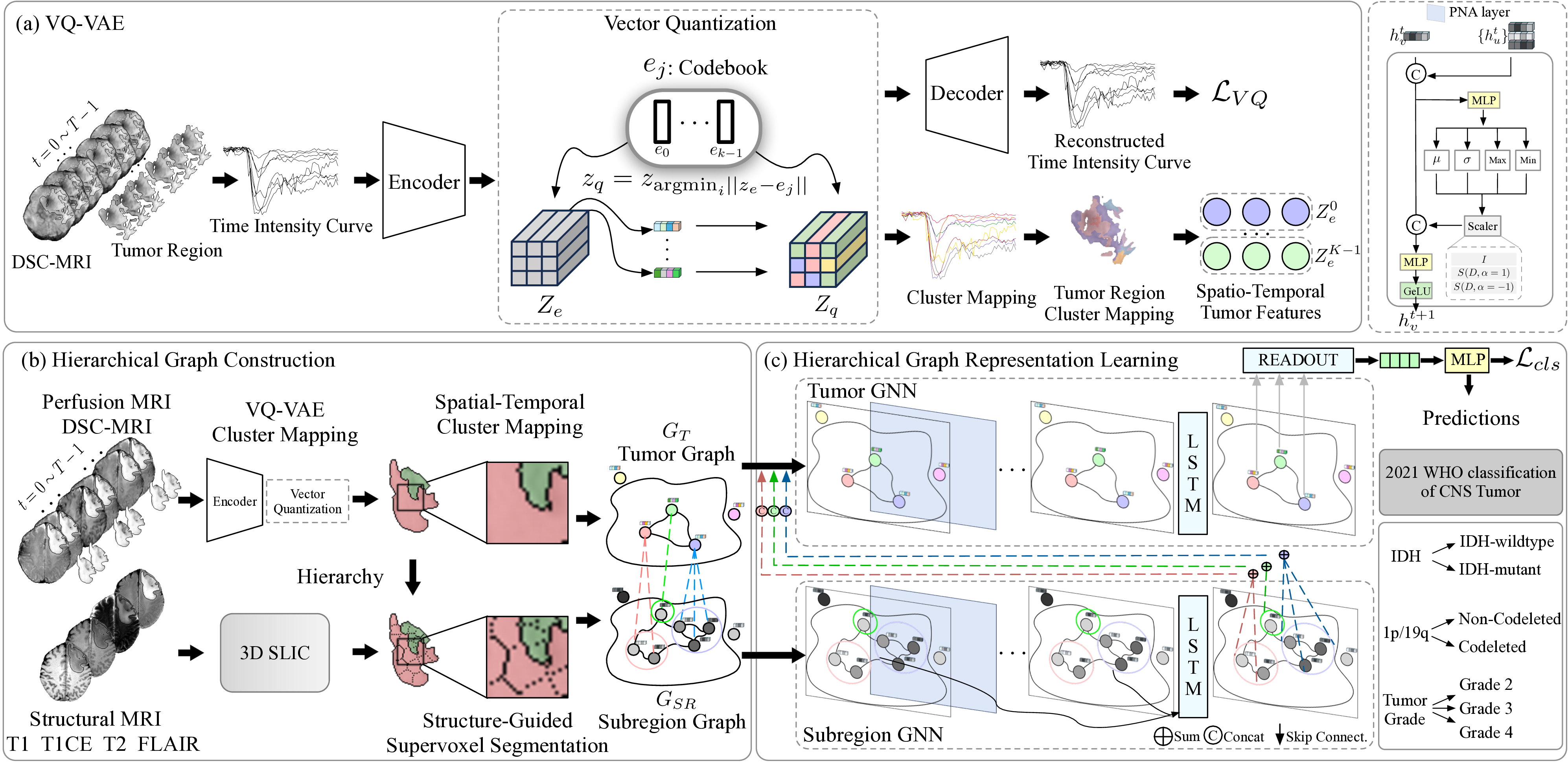
Precise molecular subtyping of gliomas, including isocitrate dehydrogenase (IDH) mutation and 1p/19q codeletion, directly guides surgical and therapeutic decisions, yet currently relies on invasive tissue sampling. Deep learning on structural MRI has emerged as a non-invasive alternative, but anatomy-only approaches cannot capture the hemodynamic signatures that distinguish molecular subtypes. Radiogenomics based on dynamic susceptibility contrast (DSC) MRI holds immense potential for non-invasively characterizing glioma molecular subtypes, yet clinical deployment has been hindered by inter-site variability and the limitations of voxel-wise analysis. We introduce HiPerfGNN, a framework that first learns discrete hemodynamic representations from raw time-intensity curves using a vector-quantized variational autoencoder (VQ-VAE). These quantized perfusion codes define coarse-level graph nodes representing functional tumor habitats, each of which is hierarchically subdivided into fine-level subregions guided by structural MRI. A hierarchical graph neural network then propagates information across scales for molecular prediction. On an internal cohort (n=475), the model achieved AUCs of 0.96 (IDH), 0.89 (1p/19q), and 0.84 (WHO grade), and maintained robust IDH performance (AUC 0.89) on an independent external cohort (n=397) without recalibration. Gradient-based saliency analysis confirms biologically grounded attention patterns aligned with known glioma pathophysiology.

Method Overview

HiPerfGNN architecture overview
Overview of HiPerfGNN. (a) A VQ-VAE encodes per-voxel time-intensity curves from DSC-MRI into discrete hemodynamic codes, yielding spatio-temporal tumor cluster maps. (b) Hierarchical graph construction derives a coarse Tumor Graph from perfusion clusters and a fine Subregion Graph from structure-guided 3D SLIC supervoxels on T1/T1CE/T2/FLAIR. (c) Hierarchical GNN with PNA layers and LSTM temporal aggregation propagates information across scales, predicting IDH mutation, 1p/19q codeletion, and WHO grade under the 2021 CNS tumor classification.

Results

Table 1: Comparative performance of radiogenomic models
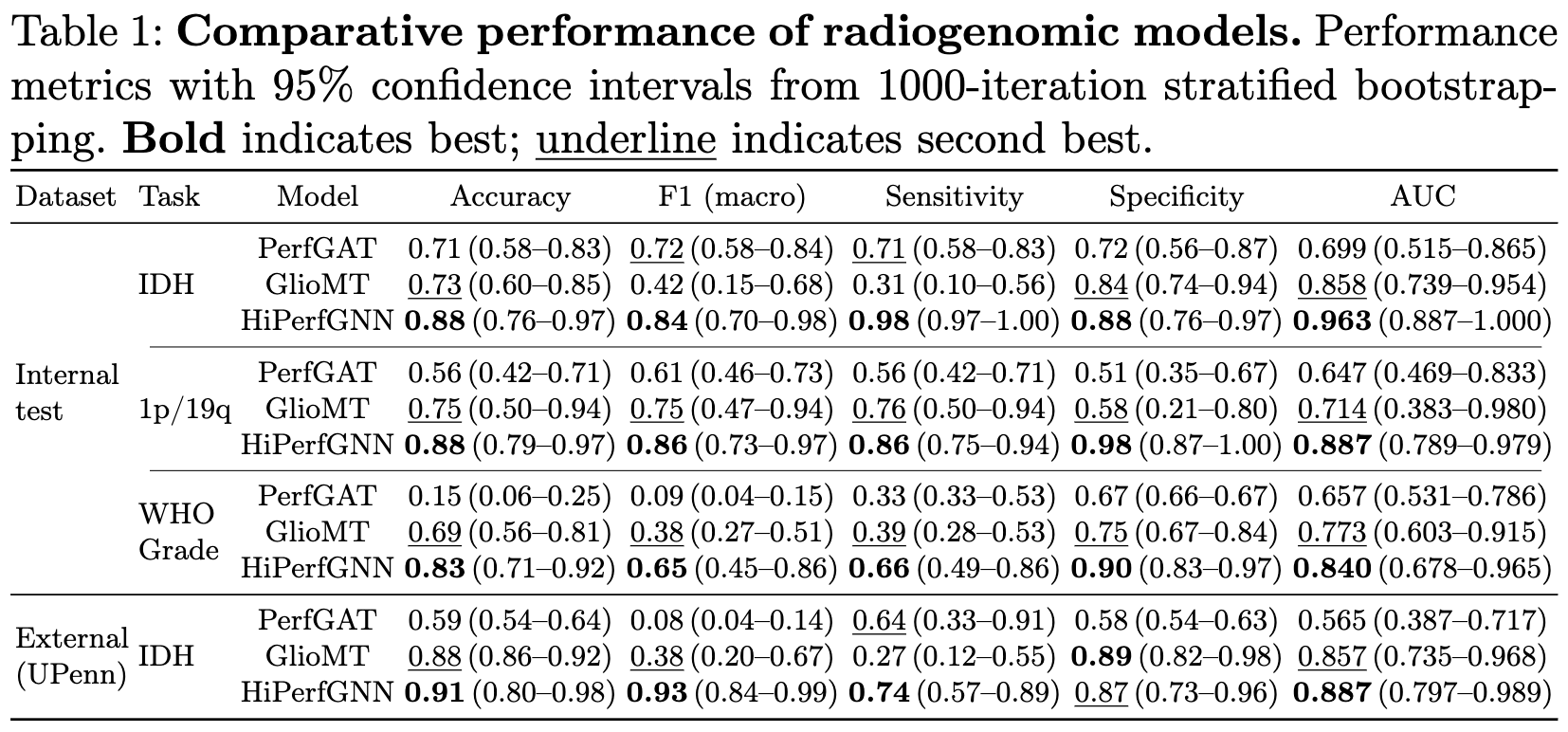
Table 1. Comparative performance of radiogenomic models. Accuracy, F1 (macro), Sensitivity, Specificity, and AUC with 95% confidence intervals from 1000-iteration stratified bootstrapping across IDH, 1p/19q, and WHO grade on the internal cohort, and IDH on the external UPenn cohort. Bold indicates best; underline indicates second best. HiPerfGNN consistently outperforms PerfGAT and GlioMT, reaching AUC 0.963 for IDH on the internal cohort and 0.887 on the external UPenn cohort without recalibration.
Table 2: Ablation study comparing graph architecture variants
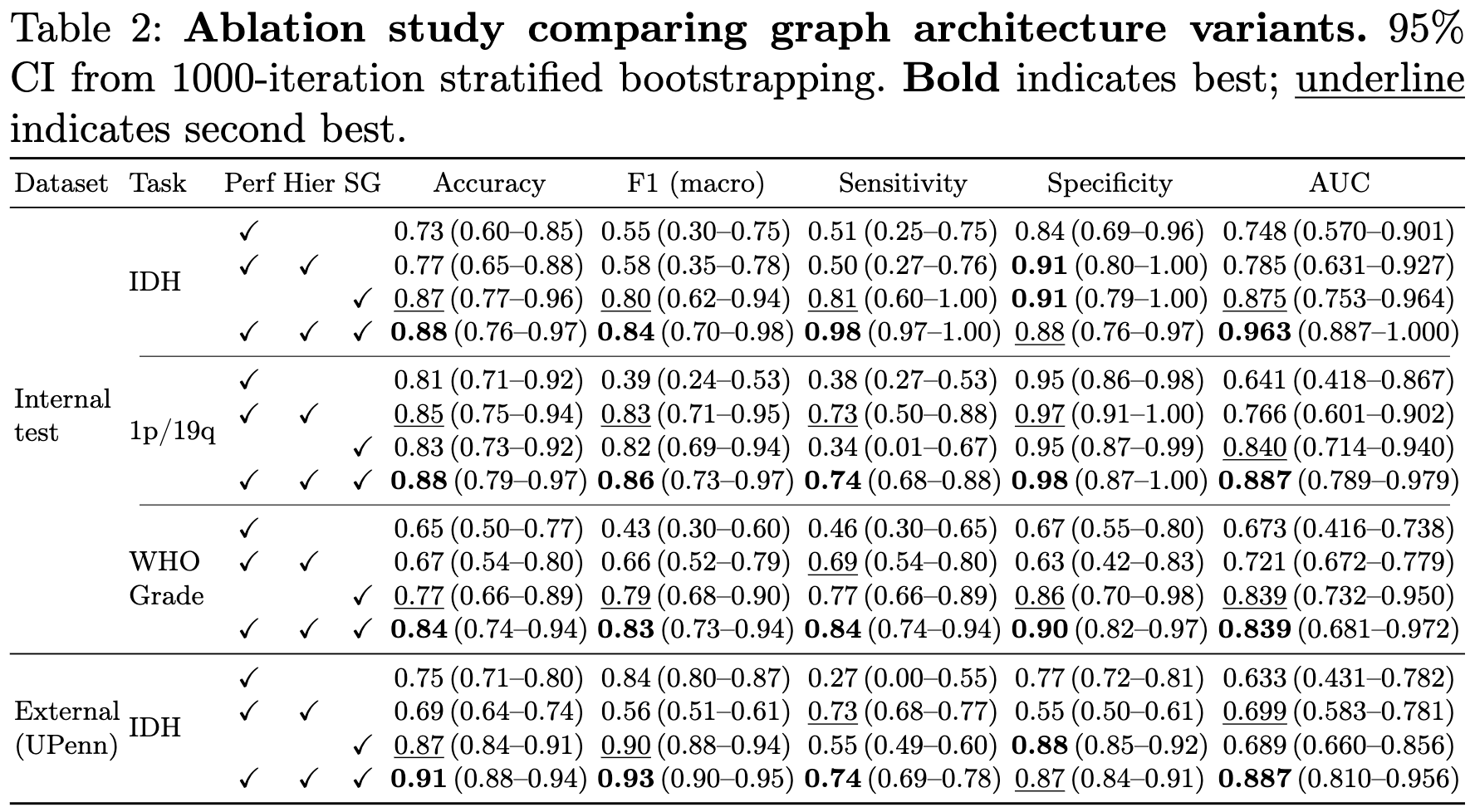
Table 2. Ablation study of graph architecture variants. Effect of Perfusion codes (Perf), Hierarchical structure (Hier), and Structure-guided supervoxels (SG). The full configuration (Perf + Hier + SG) achieves the best AUCs across every task and cohort, confirming that perfusion-aware coarse nodes and structure-guided fine subregions are both necessary for cross-site molecular subtyping.

Saliency & Tumor Heterogeneity

Gradient-based saliency maps across glioma molecular subtypes
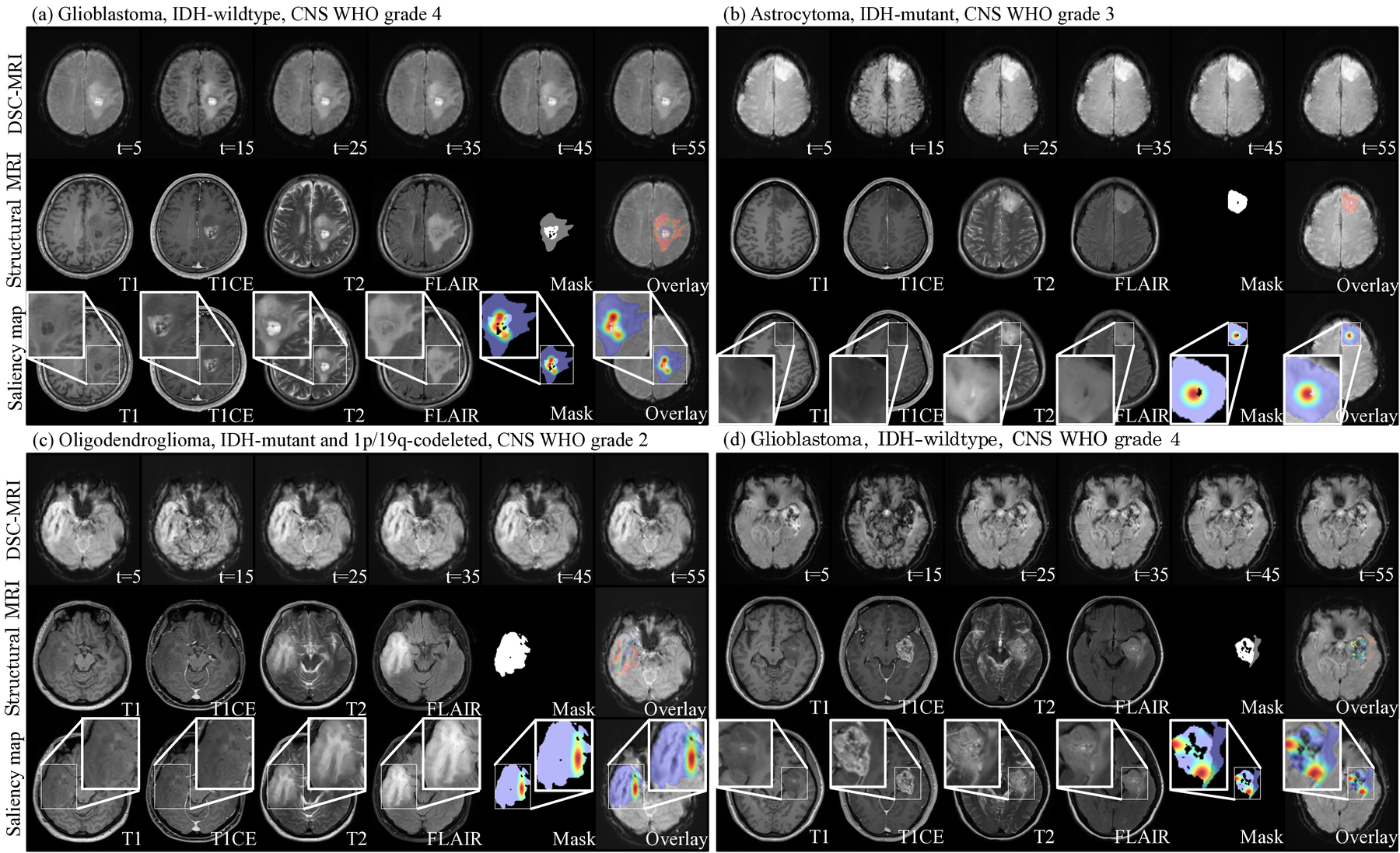
Subtype-specific saliency. DSC-MRI time-intensity curves (top), structural MRI with tumor mask and overlay (middle), and gradient-based saliency maps (bottom) for four representative cases: (a, d) Glioblastoma, IDH-wildtype, WHO grade 4; (b) Astrocytoma, IDH-mutant, WHO grade 3; (c) Oligodendroglioma, IDH-mutant and 1p/19q-codeleted, WHO grade 2. Attention concentrates on biologically meaningful regions — enhancing tumor cores in IDH-wildtype cases, and infiltrative non-enhancing tumor in IDH-mutant lower-grade gliomas.

BibTeX

@inproceedings{jang2026hiperfgnn,
  title     = {HiPerfGNN: Hierarchical Perfusion Graphs for Tumor Heterogeneity Modeling in Glioma Molecular Subtyping},
  author    = {Jang, Han and Lee, Junhyeok and Eum, Heeseong and Jang, Joon and Han, Yoseob and Choi, Seung Hong and Choi, Kyu Sung},
  booktitle = {Medical Image Computing and Computer-Assisted Intervention (MICCAI)},
  year      = {2026}
}